
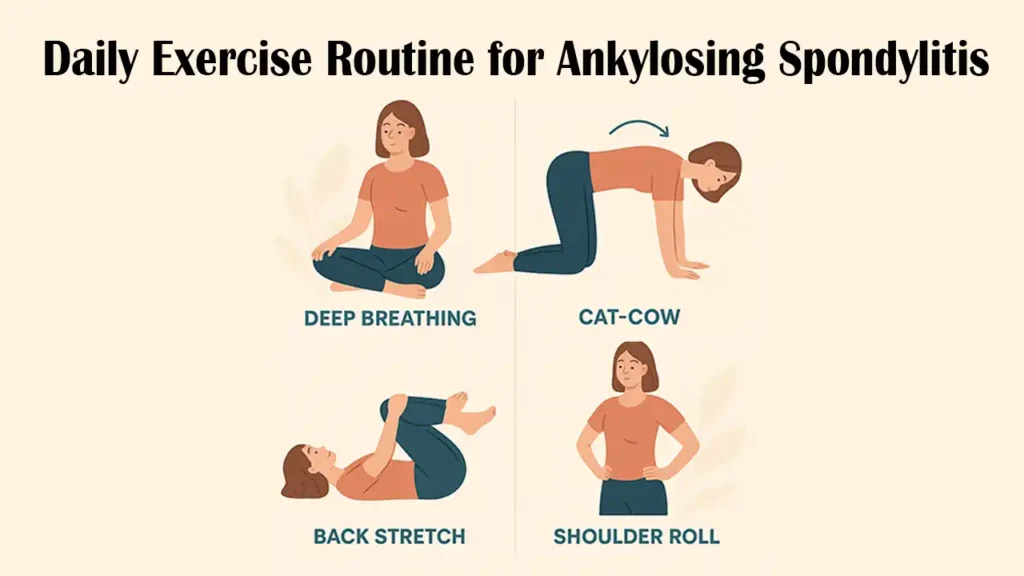

Living with Ankylosing Spondylitis (AS) can be difficult because the body feels stiff, painful, and tired. But daily exercise is one of the best ways to manage the condition. Even doctors say that exercises are as important as medicines for AS. A correct routine helps the spine stay flexible, reduces pain, and prevents long-term stiffness.
Different people have different levels of AS. Some are in the early stage, some in the middle stage, and some have advanced stiffness. That is why the exercise routine must match the stage of the condition. Below is a simple, safe, and easy-to-follow stage-wise Daily Exercise Routine for Ankylosing Spondylitis.
Early Stage Ankylosing Spondylitis (Mild Pain, Mild Stiffness)
In the early stage, people usually feel morning stiffness, lower back pain, and tiredness, but their body still moves well. The goal is to keep the spine flexible and stop future stiffness.
1. Morning Deep Breathing (5 minutes)
- Sit or lie comfortably
- Breathe in slowly
- Hold for 2–3 seconds
- Breathe out deeply
This improves chest expansion.
2. Neck Stretch (3 minutes)
- Slowly bend your neck forward
- Then backward
- Then left to right
- Hold each stretch for 5 seconds
It helps prevent future neck stiffness.
3. Back Stretch on Bed (5 minutes)
- Pull your knees toward your chest
- Hold and release
This reduces morning stiffness.
4. Cat-Cow Pose (3–5 minutes)
- Hands and knees position
- Arch your back up
- Then slowly drop your spine down
This keeps the spine flexible.
5. Shoulder Expansion Exercise (3 minutes)
- Stretch arms backward
- Pull shoulder blades together
Great for posture and upper body mobility.
6. 20–30 Minute Walk
Walking reduces pain and boosts energy.
Middle Stage Ankylosing Spondylitis (Moderate Pain, Moderate Stiffness)
In the middle stage, stiffness becomes stronger. Pain may move from the lower back to the mid-back, neck, or hips. Here, gentle but regular exercises are necessary.
1. Warm Water Yoga or Stretching (10 minutes)
Warmth reduces stiffness and makes stretching easier.
2. Hip Opening Stretch (5 minutes)
- Sit with feet together
- Gently push knees down
Helps reduce hip tightness.
3. Thoracic Spine Stretch (5 minutes)
- Sit straight
- Twist your upper body left
- Then right
Improves mid-back movement.
4. Wall Posture Exercise (3 minutes)
- Stand with your back touching the wall
- Try to keep head, shoulders, and hips aligned
Helps correct bending posture.
5. Swimming or Aqua Therapy (20 minutes)
This is one of the best exercises for AS. It supports the spine and reduces pressure on joints.
6. Gentle Strength Training (10 minutes)
Using light weights or resistance bands
- Strengthens back muscles
- Prevents future stiffness
Avoid heavy gym exercises.
Advanced Stage Ankylosing Spondylitis (High Stiffness, Reduced Flexibility)
At this stage, the spine may be more rigid. Some people have difficulty bending, lying flat, or twisting. Exercises must be slow, supported, and safe.
1. Deep Breathing with Chest Stretch (5 minutes)
Helps improve rib movement, which becomes stiff in this stage.
2. Supported Back Stretch on a Pillow (5 minutes)
- Lie down with a pillow under your upper spine
- Let your chest open
This helps reduce hunching.
3. Hip Flexor Stretch (5 minutes)
- Stand near a wall for support
- Stretch one leg backward
This improves walking ability.
4. Side-Body Stretch (3 minutes)
- Lift one arm
- Bend sideways
Good for reducing side stiffness.
5. Seated Cat-Cow (5 minutes)
If floor exercises are hard, do it seated on a chair.
6. Short Walk (10–15 minutes)
Even slow walking reduces tightness.
Important Note
If advanced stage includes spinal fusion, avoid twisting, fast bending, or high-impact exercises.
Important Tips for All Stages
✔ Exercise daily, even on bad days
✔ Move slowly and gently
✔ Avoid jerky or forceful movements
✔ Morning exercise is best, as stiffness is highest
✔ Use hot showers or heating pads before stretching
✔ Stop if pain becomes sharp or extreme
✔ Good posture is extremely important for AS patients
Why Daily Exercise is Important for Ankylosing Spondylitis
Daily exercise is the most important part of AS management.
Regular movement helps you by:
- Reducing inflammation
- Decreasing pain
- Improving spine flexibility
- Preventing stiffness
- Keeping your posture correct
- Supporting mental health
- Slowing long-term progression of AS
When you move every day, your joints remain active, and your muscles stay strong. This provides better support for your spine and reduces the chances of severe flare-ups in the future.
Common Mistakes to Avoid
- Avoid exercises that put pressure on your spine like heavy lifting.
- Do not push yourself during flare-ups.
- Avoid high-impact workouts like running on hard surfaces.
- Do not skip warm-ups.
- Avoid long hours of sitting without movement.
FAQs
1. Can daily exercise reduce Ankylosing Spondylitis pain?
Yes. Exercise is one of the most effective ways to reduce pain and stiffness.
2. Is walking good for AS patients?
Walking is safe and very helpful because it keeps the spine and hips moving.
3. Should AS patients do yoga?
Yes, gentle yoga is good. Avoid extreme bending or twisting poses.
4. Can I do gym workouts?
Light weights are fine. Avoid heavy lifting or fast movements.
5. When is the best time to exercise?
Morning is the best, because stiffness is usually highest at that time.