
How to Know if Your Symptoms Match Early, Middle, or Advanced Stage AS
Ankylosing Spondylitis (AS) is a long-term inflammation disease that mainly affects the spine, hips, and sometimes other joints. The symptoms grow slowly over months and years. Many people do not know they have AS until the pain becomes serious.
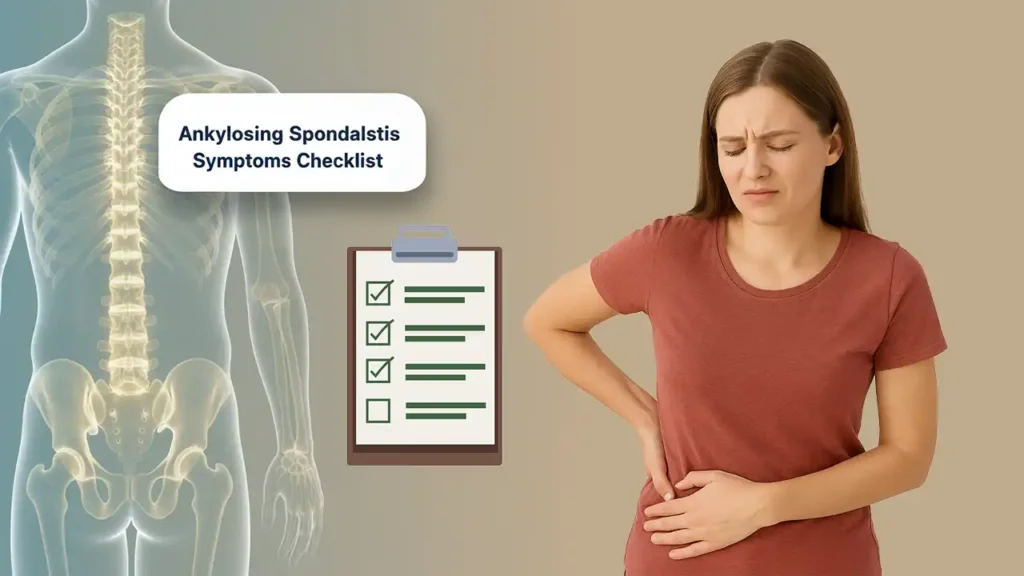
Below is Ankylosing Spondylitis Symptoms Checklist that helps you understand whether your signs point toward AS and which stage you might be in.
✅ Stage 1: Early Stage Symptoms (Most Common in Starting Years)
You may be in the early stage of Ankylosing Spondylitis if you have:
✔ Persistent lower back pain for more than 3 months
- The pain is deep and dull.
- It feels like it comes from your hips or buttocks.
✔ Pain is worse in the morning or after rest
- Morning stiffness lasts longer than 30 minutes.
- Pain becomes worse after sitting, lying, or not moving.
✔ Pain improves with movement
- Walking or light exercise reduces pain.
- Resting makes the pain worse, not better.
✔ Stiffness after waking up
- You feel “locked” in your lower back or hips.
- You need time to move normally.
✔ Alternating buttock pain (left side one day, right side another)
This is a very strong early sign of AS.
✔ Fatigue and tiredness
Your body uses energy to fight inflammation, so you feel tired often.
✔ Mild chest tightness
Breathing deeply sometimes feels slightly uncomfortable.
**If you have 3 or more of these signs for more than 3 months →
You likely belong to the early stage of AS.**
✅ Stage 2: Middle Stage Symptoms (Inflammation Spreads)
You may be in the middle stage of Ankylosing Spondylitis if you have:
✔ Pain moves to upper back or neck
Inflammation is no longer limited to lower back or hips.
✔ Stiffness spreads along the spine
Your spine feels tight, especially after resting.
✔ Rib and chest pain
Pain when taking a deep breath because the rib joints are inflamed.
✔ Heel pain or foot pain
Inflammation where tendons attach to bones (called enthesitis).
✔ Pain in shoulders, knees, or ankles
AS can spread beyond the spine.
✔ Eye redness or eye pain
Sudden red, painful, or sensitive eye — a condition called uveitis.
✔ Light bending becomes difficult
Touching toes or twisting becomes harder.
**If you have 4 or more of these symptoms →
You likely belong to the middle stage of AS.**
✅ Stage 3: Advanced / Late Stage Symptoms (Bone Fusion Begins)
You may be in the advanced stage of Ankylosing Spondylitis if:
✔ Spine becomes very stiff
Movement becomes limited. You may find it hard to bend or twist.
✔ Spine starts bending forward
You may develop a “stooped” or “hunched” posture.
✔ Chest movement reduces
Deep breathing becomes difficult because rib joints are stiff.
✔ Constant back pain that does not go away easily
Pain becomes more continuous due to long-term inflammation.
✔ Difficulty lifting head or looking straight
Neck mobility becomes limited.
✔ Frequent flare-ups
Pain episodes become more common and longer.
✔ Overall reduced mobility
Simple activities like tying shoes or turning in bed become difficult.
**If you have 3 or more of these symptoms daily →
You may be in the advanced stage of AS.**
⭐ Signs That Strongly Suggest Ankylosing Spondylitis (Confirming Clues)
These signs are considered strong indicators of AS — if you have them, there is a high chance that AS is the cause:
✔ Morning stiffness that improves with movement
This is one of the clearest signs.
✔ Pain starting before age 40
AS usually begins between 15–40 years.
✔ Alternating buttock pain
Shifts from left to right — very specific to AS.
✔ Night pain that wakes you up
Especially in the second half of the night.
✔ Eye redness with sudden blurred vision
Common in AS patients.
✔ Family history of similar back problems
AS can be genetic.
If you have these symptoms, the chances of AS are very high.
⭐ Simple Self-Check Test (Easy to Understand)
Answer YES or NO to each:
- Has your back or hip pain lasted more than 3 months?
- Do you feel worse after rest and better after moving?
- Do you wake up with stiffness more than 30 minutes?
- Do you feel pain in your buttocks on both sides, switching often?
- Do you have pain in your heels or mid-foot?
- Do you feel tightness in chest while breathing?
- Have you had sudden red, painful eyes?
- Are you below 40 years old?
If you answered YES to 4 or more →
Your symptoms strongly match Ankylosing Spondylitis.